Here's the short answer: a room feels layered and cozy when its textiles contrast on purpose — a flatwoven jute rug under a soft wool throw, smooth cotton pillows beside woven hemp. Designers who layer fabrics professionally build in three roles: a base layer that grounds the space, mid-layers that add softness and depth, and accent pieces that deliver contrast. I'll walk you through each role, the fibers that fill it, and the editing habits that keep the whole thing calm instead of cluttered.
The Foundation of Comfort: Understanding Textile Layering
Layering is how a room stops feeling flat and starts feeling lived-in. It's not about quantity — it's about mixing soft and natural textures so the eye and the hand both have something interesting to find. Robyn Huff, writing on her blog, puts it simply: mixing soft and natural textures "creates visual interest and prevents the space from feeling flat." She also notes that neutral rooms are ideal for layering, because a variety of textures within a calm palette adds depth and warmth while keeping the overall look timeless. That's the sweet spot we're after: cozy without chaos.
Core Principles for Intentional Layering
Two principles do most of the heavy lifting. First, contrast is non-negotiable. Writing for Livingetc, Emily Moorman relays designers' advice that "failing to add contrast can make a room feel flat," and that cohesion keeps things uniform while contrast keeps a room from feeling predictable. Second, build slowly and let comfort lead. Designer Lucy Currell, quoted in the same piece, says: "Build up layers slowly, and make sure the places you do layer fabrics also add comfort — do the cushions feel good to lean back on? How comfy does the pile of a rug feel underfoot?" If a layer doesn't earn its place tactically, it's decoration, not layering.
Natural Fiber Layering Framework
Here's the framework I use, built from how designers actually describe these materials. Sort every textile into a role — base, mid, or accent — then make sure adjacent layers contrast in texture. Read it top to bottom as a build order: start with the base, add the mid-layers for softness, and finish with accents that introduce variation.
| Layer Role | Texture Type | Example Natural Fiber | Typical Application | Key Characteristic |
|---|---|---|---|---|
| Base Layer | Flatwoven, rough underfoot | Jute, sisal | Large area rug defining a zone | Establishes foundational texture and warmth; lets softer layers stand out against it |
| Mid-Layer | Soft, plush, chunky | Wool | Throws, softer layered rugs, cushions | Adds softness and depth; the comfort layer you actually touch |
| Accent Layer | Crisp, smooth, or woven-organic | Linen, cotton, hemp | Pillows, poufs, smaller textiles | Introduces contrasting texture and finishes the layered look |
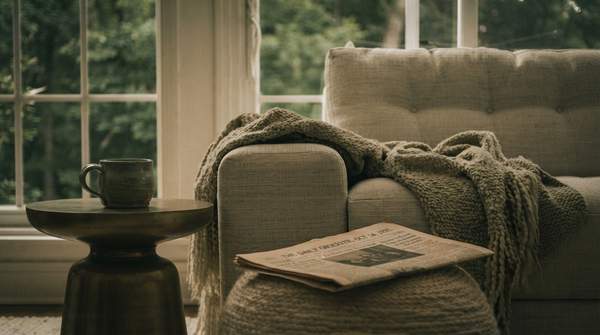
A worked example: a large flatwoven jute rug as the base, a wool throw draped on the sofa as the mid-layer, and crisp linen or cotton pillows as accents. Each step contrasts with the one beneath it — rough, then soft, then smooth.
Base Layers: Grounding Your Space with Texture
Your base layer is the floor. Huff recommends choosing a rug large enough that furniture sits partially on it, with subtle pattern or texture — and notes that natural fibers like jute and sisal "add warmth instantly." Her go-to move: a basic, larger jute rug to fill the space, then a smaller patterned rug layered over it, since smaller rugs usually cost less. That's the base role in a sentence: a flatwoven natural-fiber foundation that defines the zone and gives everything above it something to push against.
Mid-Layers: Adding Softness and Depth
Mid-layers are where the cozy happens. Wool is the star here — soft, often chunky, and plush to the touch. This is the layer Currell's comfort test applies to: does the cushion feel good to lean back on? Does the rug's pile feel good underfoot? In the bedroom, the goal, as interior designers describe it, is softness that feels intentional rather than messy — a wool throw folded at the foot of the bed does exactly that. Keep mid-layers in the colors you touch most, because they're the textiles you'll live against.
Accent Layers: The Finishing Touches of Contrast
Accents are smaller, and they're where contrast gets playful. Layering guidance from Cottage & Bungalow sums up the whole method in a formula: "Add something soft beside something structured. Something woven beside something smooth." A hemp pouf — like the natural hemp fiber example designers have styled as an ottoman, extra seat, or tray-topped accent surface — brings a woven, organic texture into the room. Crisp linen and smooth cotton pillows sit nicely against a chunky wool throw. Two or three of these finishes, and the room reads as styled rather than assembled.
Refining Your Layers: Avoiding Common Mistakes
Two failure modes: flat and cluttered. Flat happens when every textile matches in texture — the designers Moorman interviewed call a lack of contrast the fastest way to a bland room. Cluttered happens when you skip the slow-build step. Currell's advice on the small details applies to the whole room: "don't overdo it." Huff's budget trick helps here too — layer a smaller rug over your jute base rather than buying one huge statement rug, and you add a material contrast without crowding the floor. Edit one layer at a time, and stop when it feels warm rather than busy.
Achieving Your Cozy Aesthetic
So here's your decision path: establish a neutral base with a flatwoven jute or sisal rug, add wool mid-layers for softness and depth, then finish with crisp or woven accents — linen, cotton, hemp — for contrast. Currell's studio works only in natural fibers because, in her words, "They always look elegant, drape well, and are better for your health." That's a strong endorsement, though the elegance and drape are what matter most here. You'll know the method worked when the room feels rich, styled, and genuinely lived-in — a balanced interplay of textures rather than a flat matchy-matchy scheme or a cluttered pile of stuff. Stand in the doorway and squint: if your eye finds three distinct textures — rough, plush, smooth — you've layered it right.
Sources
- I Asked Interior Designers How to Layer Fabrics to Make My Living… — Livingetc
- How to Add Layers in Home Decorating: Creating a Warm, Collected Living Room - Robyn's French Nest — Robyn\'s French Nest
- 7 Steps to a Cozy, Collected Home: How to Layer Textures — Cottage & Bungalow