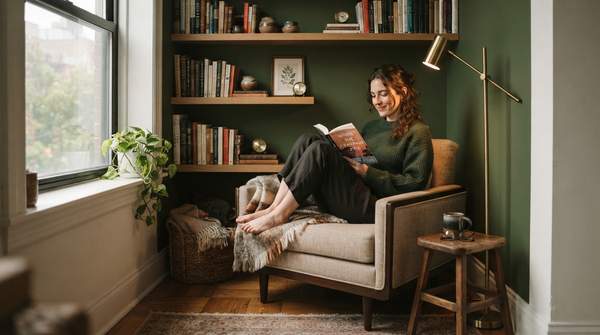
You don't need a spare room for a reading nook. You need an awkward corner, a window, or the dead space under your stairs—and the right components for that exact spot. The trade-off in every small nook is the same: comfort versus footprint. A built-in bench with hidden storage wins on efficiency; a compact armchair wins on flexibility. Here's how to choose, based on what designers and small-space guides actually recommend.
Finding Your Nook: Utilizing Unconventional Spaces
Start by hunting for space you're already wasting. Interior designer Michael Helwig's roundup of small-room nooks highlights three recurring locations: under the stairs, forgotten corners, and window walls. His favorite example is a "secret book nook" tucked under a staircase, with storage built under the bench seating—what he calls a "masterful use of space."
Corners are the most forgiving option. Helwig shares one homeowner's solution for a genuinely tricky living-room corner blocked by a heating element and a doorway: she turned it into an open reading corner, using the wall between the corner and the heater for low-profile book racks. The lesson? Measure your constraints first, then pick components that respect them.
Window areas bring a bonus. BenQ's reading nook guide notes that window seats offer natural light, which it cites (via Healthline) as enhancing mood and concentration. BenQ recommends a window seat at least 36 inches wide and 16 inches deep. Under-stair benches, it suggests, work at roughly 30 by 15 inches—though that space may need custom-built furniture rather than ready-made pieces.