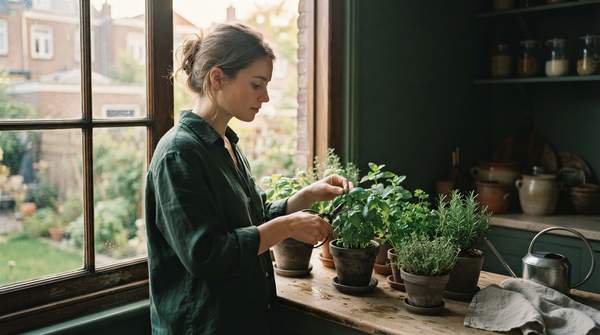
The single biggest decision you'll make when growing herbs indoors is matching the plant to your window. Herbs grown for their leaves—parsley, cilantro, mint, and chives among them—can get by on just 3 to 4 hours of direct sun, while basil, rosemary, and oregano simply won't thrive without your sunniest spot. Get that pairing right, and indoor herb gardening becomes one of the easiest ways to keep fresh flavor at arm's reach. Get it wrong, and no amount of attentive watering will rescue a pale, stretched-out plant sitting in the wrong light.
Introduction to Low-Maintenance Indoor Herb Gardening
When I put my first pots of basil and thyme on a kitchen shelf years ago, I assumed watering was the whole job. It isn't. As horticulturist Aaron Steil of Iowa State University's extension service puts it, "Light is typically the most limiting factor to successfully growing herbs indoors." That's the quiet truth behind nearly every failed windowsill garden: not neglect, but dim rooms.
The good news is that the rest of the care routine is forgiving. Steil's guidance notes that typical indoor temperatures suit herbs well, that soil should be allowed to dry between waterings, and that clay or terracotta pots—porous, drying out readily—make excellent homes for them. Well-drained potting mix and a container with drainage holes round out the basics. This guide covers growing established plants indoors, not starting from seed, and focuses on basic care rather than pest or disease management.
Matching Herbs to Your Home's Natural Light
The framework is simpler than it looks. Gardenary founder Nicole Johnsey Burke, writing from her experience building gardens in tree-shaded city yards, divides herbs into two practical tiers. Herbs grown for their leaves—parsley, cilantro, dill, mint, and chives—grow well with just 3 to 4 hours of direct sun. Your sunniest spots, meanwhile, should be reserved for basil, rosemary, and oregano, because in her words they "won't thrive in low light."
Steil's extension guidance raises the bar for the whole group: most herbs need around eight hours of direct light daily indoors, with a south-facing window the best candidate and a bright east- or west-facing window a good alternative. In practice, the low-light tier is the one that tolerates the less sunny exposures, while the high-light tier demands your brightest glass. Rise Gardens' beginner guide, authored by Dan Kuhn, recommends positioning herbs where they receive 6+ hours of direct sunlight daily, keeping pots 4–6 inches from cold window glass, and rotating pots 90 degrees weekly for even growth.
Herb Selection Guide by Light Condition
Use this table to classify each herb before you buy, based on the sunlight your window actually delivers. The tiers follow the quantified daily direct-sun requirements in the evidence: low-light herbs manage on roughly 3–4 hours, while high-light herbs need 6 or more.
| Herb | Minimum Direct Sunlight | Light Tier | Potting Preference |
|---|---|---|---|
| Mint | 3–4 hours | Low light | Own pot — aggressive roots |
| Parsley | 3–4 hours | Low light | Groups with cilantro — cooler temps, moist soil |
| Cilantro | 3–4 hours | Low light | Groups with parsley — cooler temps, moist soil |
| Chives | 3–4 hours | Low light | Groups with thyme and oregano — similar light and water needs |
| Thyme | Tolerates lower light, grows slower in part shade | Low light (slower) | Groups with oregano and chives |
| Basil | 6+ hours | High light | Own pot — fast grower with deep roots |
| Oregano | 6+ hours | High light | Can group with thyme and chives in bright light |
| Rosemary | 6+ hours | High light | Own pot — woody and large |
Two cautions from the sources themselves. Cilantro "bolts quickly in warm conditions and has a short growing cycle," according to EarthBox's indoor growing guide, so it's a temporary tenant even when it's happy. And rosemary sits in a second tier of indoor herbs that Steil describes as "successful indoors but have higher than normal light requirements and/or significant pests," so it's trickier than basil or oregano despite sharing their demand for sun.
Optimal Potting and Grouping Strategies
Once you've matched herbs to light, match them to each other. The EarthBox guide draws a clean line between herbs that prefer their own space and herbs that play well together. Mint earns a solo pot for its aggressive roots, rosemary for being woody and large, and basil for being a fast grower with deep roots. Give any of these three a shared container, and they'll crowd out their neighbors before the season turns.
For grouping, the same guide pairs thyme, oregano, and chives on the basis of similar light and water needs, and parsley with cilantro on the basis of cooler temperatures and moist soil. The rule is simple: if a multi-section planter is your setup, grouped herbs must share growing preferences. Pairing a thirsty parsley with a drought-tolerant thyme guarantees one of them is miserable. And regardless of grouping, remember that containers that are too large stay wet too long—Steil's guidance is to size pots appropriately and let soil dry between waterings, since most herbs don't tolerate wet feet.
Recognizing and Resolving Insufficient Light
Even a well-matched plant will tell you when the light falls short, and it tells you through its leaves. Kuhn's Rise Gardens guide instructs gardeners to "monitor leaf color and stem spacing—pale leaves or long gaps between leaf sets indicate insufficient light." A healthy herb produces compact, green growth; a light-starved one stretches toward the window on pale, elongated stems.
Those symptoms can point to other problems too, but insufficient light is a common cause indoors, and the fixes are straightforward. First, move the plant to a sunnier location. If no brighter window exists—Burke notes that during the short days of winter it may not be possible to give herbs the natural light they need on a windowsill—supplement with an artificial grow light. She recommends a full-spectrum light, such as clip-on LEDs that attach to a shelf or ledge above the herbs, run on a timer. Because artificial light isn't equivalent to natural light, these lights should stay on for 12 to 14 hours a day. Rise Gardens adds a placement detail: position LED grow lights about 12 inches above the plants.
Ensuring Long-Term Herb Health
The decision this whole framework supports is simple: regularly assess your herbs' growth and leaf appearance to confirm they're getting adequate light, then adjust placement or supplement with a grow light as needed. Walk through the routine weekly—rotate pots 90 degrees, check leaf color, look at the spacing between leaf sets—and you'll catch problems while they're still reversible.
Your measurable indicator of success is this: new leaf growth should be compact and green, without excessive stem elongation or pale coloration. When new leaves come in tight and deeply colored, your herb is matched to its light and its pot, and your windowsill garden is doing exactly what it should. When they don't, you now know the two moves—more window, or a grow light—and the low-light tier to fall back on if your home simply doesn't offer six hours of sun.
Sources
- Growing Herbs Indoors — Yard and Garden
- How to Start an Herb Garden Indoors • Gardenary
- The Complete Beginner's Guide to Indoor Herb Gardening — Rise Gardens
- Growing Herbs Indoors – The Complete Guide — Earthbox