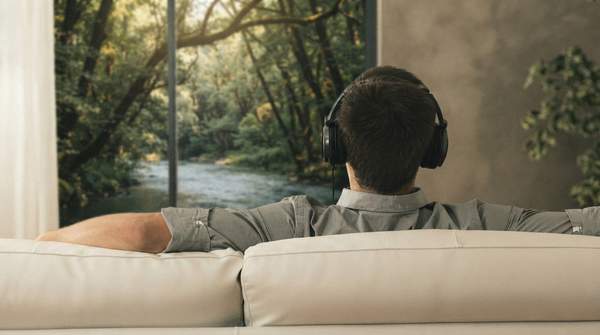
You can build a playlist that does a specific job — helping you focus, unwind, or find energy — but only if you stop thinking in genres and start thinking in characteristics. Tempo, instrumentation, and lyrical content matter far more than whether a song is labeled "lo-fi" or "ambient." Here is a practical method: define the activity first, match the music's characteristics to it, and then test the playlist in the actual space where you'll use it.
The Science of Sound: How Music Shapes Your Mood
Why does any of this work? A scoping review of sound interventions in adults points to a mechanism the music therapist Thaut describes as acoustic resonance: the listener's mood aligns with the emotional context conveyed in the sound, because the brain naturally synchronizes with rhythmic stimuli. In other words, music doesn't just accompany your mood — it can actively pull it somewhere.
The same review adds two caveats I find genuinely useful for home listening. What counts as "relaxing" is highly context-dependent, shaped by your previous exposure, traditions, and sociocultural associations — which is why my calming track might grate on you. And the method of delivery matters too: the review notes that live music appears to have stronger effects on stress markers than prerecorded music, likely because of live performance's interactive, dynamic nature.
Defining Your Playlist's Purpose: Activity and Mood
Before you add a single song, name the job. The therapist-focused guidance from Abundance Therapy Center, authored by Christine Chae, LCSW, puts it plainly: a purpose-driven approach ensures your selection is tailored to your specific emotional and psychological needs. Are you looking for a way to relax after a long day? A boost of energy during your morning routine? A focus-enhancing background for studying or working?
I'd add a refinement: define the activity, not just the mood. "Music for relaxing" is vague; "music for reading on Sunday evening with tea" gives you something concrete to test against. Once you've named the moment, you can move from vague intentions to specific musical characteristics — the real levers you'll pull.
Your Home Activity Playlist Decision Framework
The music curator Kono Vidovic offers the clearest guidance I've found on matching characteristics to moods, particularly on the lyrics question: for focus work, instrumental music is generally better, because lyrics compete with reading and writing, while songs with meaningful lyrics often enhance emotional moods like wistfulness or nostalgia. Combine that with the physiological findings, and you get this working matrix:
| Activity / Goal | Key Musical Characteristic | Rationale (Why it works) | Example Playlist Concept |
|---|---|---|---|
| Deep focus work | Instrumental; minimal or no lyrics | Lyrics compete with reading and writing, Vidovic advises; rhythmic stimuli may also aid concentration by influencing brainwave activity, per the scoping review | Slow-building instrumental playlists for desk work |
| Relaxation / unwinding | Slower tempo, instrumental, low tones | Meta-analytic evidence summarized by SelfDecode's Aleksa Ristic reports music therapy lowered anxiety, blood pressure, heart rate, and cortisol; researchers suggest relaxing music be instrumental with a beat of 60–80 bpm for maximum benefit | Low-tone instrumental evening wind-down |
| Energy and motivation | Upbeat tempos, strong rhythms, higher BPM; inspiring lyrics can help here | Vidovic recommends upbeat tempos and strong rhythms for energy; a general mental-health blog tip holds that higher beats per minute help maintain energy for activity | Fast-tempo cleaning or morning-routine playlist |
The point of the framework is that each cell is a filter, not a genre label. When you're auditioning tracks, ask: is this instrumental? Is the tempo in the right range? Does the rhythm push or soothe? Those questions move you past "this is supposed to be calming" toward music that actually is, for you.
Curating for the Space: Headphones vs. Room Audio
Here is the pitfall most people miss. Vidovic draws a sharp line between a personal mood playlist and a room soundtrack, and I think his framing is worth quoting in spirit: a mood playlist is built for one listener with headphones and full attention, while a room has a noise floor, competing conversation, and people arriving mid-track — so it needs longer blocks, fewer sharp transitions, and far more tolerance for being half-heard.
His observation from practice is blunt: most personal playlists sound thin the moment they leave the headphones. So a playlist you've perfected for your commute will likely disappoint in your living room. The two formats are different objects with different requirements, and treating them as interchangeable is the fastest route to a soundtrack nobody notices — or one that actively irritates.
Refining Your Playlist: Iteration and Personalization
Building the playlist is only half the work; testing it is the other half. Vidovic reports that a focus playlist assembled at a desk in silence always turns out to have about three tracks that break concentration — and you will not hear them until you are actually trying to work. The failure mode only shows up in the real environment, which is exactly where you need to evaluate it.
Personalization matters just as much. Vidovic's advice is that other people's playlists work as a starting point, but the most effective mood playlists are personalized, because the emotional associations you carry with specific songs are unique to you. The scoping review supports the underlying logic: responses to sound are shaped by previous exposure and sociocultural meaning, so there is no universal "relaxing" tracklist. Someone else's perfect sleep mix may leave you cold, and that's a finding, not a failure.
So the loop is: define the activity, draft using the characteristic filters above, then play it in the real space during the real activity, and remove what fails. Repeat. Each pass gets you closer to a set of tracks that genuinely does the job.
Crafting Your Ideal Home Soundscape
The decision, then, is simple to state: intentionally select music based on specific characteristics — tempo, instrumentation, lyrical content — aligned with your desired mood and activity, and test each playlist in your actual home environment rather than on assumptions. The scientific grounding makes this more than superstition: rhythmic stimuli can modulate psychological states, and music interventions have measurable physiological effects on relaxation.
One boundary worth respecting: this is a curation and well-being practice, not a substitute for professional mental health advice or therapy. If relaxation or focus is chronically out of reach, music is a support, not a treatment.
You'll know your method has worked when the result is measurable in your own life: you've created a playlist that consistently enhances your focus, relaxation, or energy for a specific home activity, as evidenced by your subjective experience and task performance. That is the whole test. If Sunday evening with the instrumental playlist now reliably means a calmer wind-down — you've built it right. If three tracks still break your concentration, you know exactly what to cut.