Open-plan living gives you light, air, and room to entertain, but it takes away something quieter and more intimate: the sense that each part of your home has its own purpose. The good news is that you do not need walls to get it back. Four textile solutions—area rugs, curtains, fabric screens and felt panels, and large textile art—each divide space in a different way, trading visual separation, sound absorption, light, and flexibility against one another. Here is how I think about choosing between them, and how to combine them.
Understanding Textile Room Dividers for Open-Plan Spaces
House & Garden's editors note that while open-plan living offers "a sense of space, room for entertaining, plenty of light and air," it is often desirable to separate spaces according to function, and that the solution can range from "flexible, temporary options such as folding screens or curtains" to more permanent installations like bookcases or partition walls. Textiles sit at the flexible end of that spectrum, which is precisely their appeal in a rented flat or a home you want to keep adaptable.
What textiles do especially well, according to interior design writers at Fibre2Fashion, is introduce balance without diminishing architectural clarity: rather than competing with open sightlines and hard surfaces, they reinforce them by creating smoother transitions between materials and spaces, and their flexibility lets interiors evolve over time. That is the philosophy behind everything that follows—zoning through softness rather than structure.
Area Rugs: Defining Zones from the Ground Up
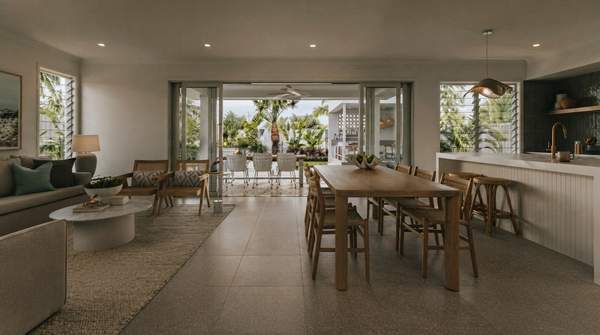
A rug is the gentlest form of division there is. It draws an invisible boundary on the floor that everyone reads instinctively: step onto the rug, and you have entered the living area. Fibre2Fashion's coverage of modern interiors describes how area rugs define functional zones within open plans, working alongside upholstered furniture to anchor larger spaces with visual weight and warmth.
Rugs also pull their weight acoustically. Writing at WhatSize, interior design bloggers explain that rugs "help define specific zones in open-concept layouts while also offering acoustic benefits by reducing echo and footfall noise." That second benefit matters enormously in the very homes most likely to be open-plan—those with stone finishes, concrete surfaces, and expanses of glass, where sound has nothing soft to land on.
The trade-off is obvious: a rug separates zones visually but blocks no sightlines and no noise travelling at head height. Its acoustic contribution depends on material density and thickness—a flatweave does far less than a thick wool pile. In return, it is the most flexible option of all, easily rolled up and repositioned whenever your layout changes.
Curtains: Flexible Separation and Light Control
Curtains are the only textile divider that gives you a dial rather than a fixed setting. Hung across an opening or a sleeping corner, they can be drawn for instant privacy or swept back to restore the full open plan. Floor-length drapery can even visually increase ceiling height, as Fibre2Fashion points out, which makes curtains a rare divider that adds rather than subtracts perceived space.
On acoustics, curtains genuinely help, and the physics is well established. FibreGuard's technical guidance on fabric acoustics confirms that curtains do improve room acoustics, and that "layering multiple fabric types gives the best combined performance, especially combining an absorbing face with a denser backing." Acunic, an Australian acoustic textiles specialist, explains that both NRC and αw measure sound absorption on a 0–1 scale using different testing standards (ASTM C423 and ISO 11654 respectively)—higher values mean more absorption. In practice: heavy, dense, layered fabric absorbs meaningfully; a single sheer panel mostly does not.
Visual separation varies with opacity and material, so choose accordingly—sheers filter light and soften boundaries, while blackout-weight fabric creates a genuinely private room-within-a-room. The one thing curtains demand is a mounting track, which is a small commitment but worth it for the light control no other textile divider offers.
Fabric Screens and Felt Panels: Privacy and Sound Absorption
If curtains are a dial, a fabric screen is a movable wall. IKEA's own room divider guidance frames these as "an easy and affordable way to enhance privacy and create defined spaces within a space," noting that a simple screen "helps to instantly create a space-within-a-space, such as a quiet corner for reading in a large living room." Screens also hide clutter, which matters in homes where the office, dining table, and sofa all share one field of vision.
On sound, screens are honest about their limits: IKEA notes that room dividers "work well in conjunction with sound absorbing panels to help reduce some noise, but are more effective at providing better focus without the visual distraction of the broader room." In other words, their strongest acoustic role is enabling concentration by removing visual noise rather than absorbing much sound on their own.
Felt and other dense panel materials are the exception. Acousart's materials guide explains that "higher density and thicker panels generally improve low-frequency sound absorption," with dense polyester or wool capturing deeper tones while lighter materials address mid-to-high frequencies—balanced coverage coming from combining densities. Opacity and height determine how much sight is actually blocked, so a half-height screen gives suggestion where a full-height one gives seclusion.
Textile Art Installations: Aesthetic Zoning with Acoustic Benefits
Large textile art—a substantial woven wall hanging or a suspended fabric installation—is the option people forget, and in many ways the most elegant. Where a rug zones the floor and a screen zones the eye level, a large textile piece marks a zone with colour, texture, and craft, anchoring a dining area or reading nook without dividing anything in half. WhatSize's design writers note that fabric wall hangings can "subtly change the spatial arrangement, add visual layers, and architectural edges," while also absorbing sound and reducing echo, as rugs do.
Houzz's feature on open-floor-plan separation points to a related idea: an art installation can cordon off one area from another—a Montana home used a sculptural installation to separate the dining area from the living room—demonstrating that the artwork itself can serve as the divider, not just decoration beside one.
Be clear-eyed about the acoustics, though. Textile art's acoustic benefits are secondary to its visual impact and depend entirely on material and construction: a dense, felt-backed piece absorbs meaningfully, while a loosely woven decorative hanging is mostly aesthetic. Panels built specifically for acoustic wall art can be sized and tuned to the space, as Acousart explains, and are increasingly designed to look like art rather than office treatment.
Textile Room Divider Comparison Matrix
The table below evaluates each solution against the three criteria that matter most in an open plan: how well it separates visually, what it does for sound, and what it costs you in natural light and flexibility. Match your primary goal—privacy, quiet, or light—to the row that serves it best.
| Textile Solution | Primary Function (Visual vs. Acoustic) | Flexibility / Permanence | Impact on Natural Light |
|---|---|---|---|
| Area rugs | Visual: defines zones on the floor plane; acoustically reduces echo and footfall noise (density and thickness dependent) | Highly flexible; easily repositioned or removed | None; light passes freely across the whole plan |
| Curtains | Visual separation that varies with opacity; sound absorption improves with heavy, dense, layered fabrics | Flexible once a track is mounted; drawn or opened at will | Adjustable—sheers preserve light, heavy fabrics block it; drapery can visually raise ceiling height |
| Fabric screens & felt panels | Privacy and defined spaces; focus benefits exceed direct noise reduction, though dense felt panels absorb lower frequencies | Freestanding and movable; no installation commitment | Can shade zones if tall or opaque; position away from windows to preserve light |
| Textile art installations | Primarily aesthetic zoning that anchors an area; secondary echo reduction depending on material and construction | Semi-permanent hanging; repositionable with effort | Minimal; hung vertically, it rarely blocks window light |
Read as a decision framework: if your problem is echo, choose density—felt panels or heavy layered curtains. If your problem is privacy, choose opacity and height—screens or blackout curtains. If your problem is only vagueness, a rug and textile art will define zones without costing you a single lumen.
Layering Textile Solutions for Enhanced Functionality
The most successful open-plan homes rarely rely on one divider; they layer textiles so each does the job it is best at. Fibre2Fashion's editors describe exactly this: rugs define conversation areas, curtains frame architectural openings, and upholstery creates visual anchors that distinguish functional zones "while preserving overall harmony," with repeated complementary fabrics and related weave structures tying the whole plan together.
A practical pattern comes from Pillovely's zoning guide: combine "a soft rug under your living room furniture" with warm-toned lighting to create an intimate "lounge island" that feels distinctly separate from the hard surfaces of a kitchen. Extend that logic by adding a fabric screen behind the seating for occasional privacy within the rug-defined zone—soft floor boundary below, visual barrier at eye level, neither one permanent.
Another layering route: use a curtain to enclose a work nook, then place a rug inside it and hang textile art on the nearby wall, so the nook reads as a complete room with its own floor, walls, and focal point. The effectiveness of layering depends on thoughtful selection and placement—each textile should complement the others' strengths rather than duplicate them.
Choosing and Combining Textile Dividers for Your Home
Select textile room dividers based on your primary need for visual separation, acoustic control, or light management, and consider layering multiple solutions to achieve a more nuanced and functional design. Start with the zone that bothers you most: echo and footfall noise point toward dense rugs and layered or felt solutions; a lack of privacy points toward curtains and screens; vague boundaries with light to spare point toward rugs and textile art.
The measure of success is simple and observable: the successful creation of distinct, comfortable zones within your open-plan space, evidenced by improved privacy, reduced noise, and appropriate light levels. Walk your home after your first layer is down, clap once in the echo-prone corner, and sit in each zone at the hour you actually use it—if the boundaries read clearly and the sound and light feel right, you have zoned it well.
Sources
- Clever room divider ideas for open-plan living — House & Garden
- Fibre2fashion
- Understanding the Role of Textiles in Interior Design — Whatsize Online
- Fibreguard
- Room Dividers - Screen Room Dividers — IKEA
- What Are the Best Materials for Acoustic Wall Art? — Acousart
- 15 Ways to Create Separation in an Open Floor Plan — Houzz
- Room Divider Ideas – How to Split an Open-Plan Space Into Zones Without Building Walls — Pillovely