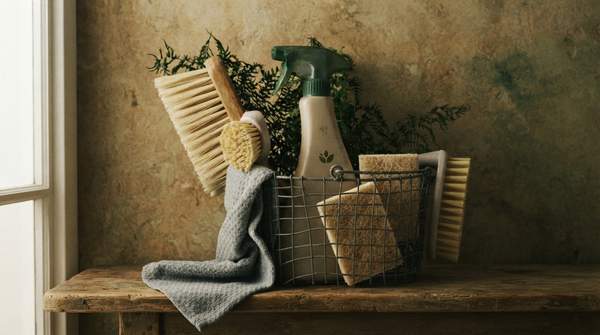
You can clean most of your home with a short list of pantry ingredients—vinegar, baking soda, liquid soap, washing soda, borax, and a few drops of essential oil. A green cleaning brochure prepared for a community environmental program hosted by the U.S. Environmental Protection Agency offers three distinct formulas: an antiseptic all-purpose cleanser, a baking-soda soft scrubber, and a vinegar-based acid cleaner. Each suits a different job, and each has surfaces it should never touch. Here is how to choose, mix, and use them safely.
The Benefits of Natural Home Cleaning
Making your own cleaners keeps the ingredient list short and transparent. The EPA-hosted brochure's recipes take about a minute each to prepare, use common household staples, and produce small, practical batches—two cups of all-purpose spray, half a cup of soft scrub, one cup of acid cleaner. Two of the three keep indefinitely, so you can mix once and refill a labeled spray bottle as needed.
There is one important boundary to keep in mind: these are cleaning recipes, not registered disinfectants or sanitizers. Even where a source uses the word "disinfect," as the brochure does for its all-purpose formula, homemade mixtures are not tested and approved the way commercial disinfecting products are. If you need to disinfect—say, after raw chicken on a counter—use a product specifically tested and labeled for that purpose.
Natural ingredients also let you tailor fragrance to your preference. Essential oils add scent, and the brochure suggests antiseptic options such as thyme, sweet orange, lemongrass, rose, clove, eucalyptus, cinnamon, rosemary, birch, lavender, or tea tree. Treat these as aromatic and general cleaning choices rather than proven antimicrobial treatments.
Key Natural Cleaning Ingredients and Their Uses
Each recipe works because of one active ingredient, and matching that ingredient to the mess is the whole trick.
- White vinegar is acidic, with a pH of about 2, according to naturopath Lauren Glucina, who writes that it breaks down grease, mold, and mineral deposits in kitchens and bathrooms. That same acidity is why it must stay away from marble, which it can erode.
- Baking soda is a gentle abrasive. In the soft scrubber, it provides the scrubbing power for sinks, tubs, and shower stalls without harsh chemicals.
- Washing soda and borax boost the all-purpose cleanser's cleaning power; the brochure combines them with liquid soap and hot water.
- Liquid soap or detergent appears in all three recipes, cutting through grease and helping the mixtures spread and rinse cleanly.
- Essential oils contribute fragrance and, in the brochure's all-purpose formula, antiseptic properties.
Water quality matters more than you might expect. Glucina notes that water is a medium for bacterial growth, so she recommends distilled water, or water boiled and cooled, for natural cleaning products.
Choosing Your Natural Cleaner: A Recipe Comparison
Use this table to match your cleaning task to the right formula. The classification is simple: the all-purpose cleanser is a general mineral-and-soap spray, the soft scrubber is abrasive, and the acid cleaner is vinegar-based.
| Cleaner Type | Key Ingredients | Best For (Surfaces) | Avoid On | Safety Note |
|---|---|---|---|---|
| Antiseptic All-Purpose Cleanser | Up to 1 tsp antiseptic essential oil (thyme, sweet orange, lemongrass, rose, clove, eucalyptus, cinnamon, rosemary, birch, lavender, or tea tree), 1 tsp washing soda, 2 tsp borax, ½ tsp liquid soap, 2 cups hot water | General hard surfaces; spray and leave about 15 minutes before wiping | The brochure lists no specific exclusions for this formula—always test an inconspicuous spot first | Combine in a labeled spray bottle; shake to dissolve. Shelf life: indefinite |
| Basic Soft Scrubber (abrasive) | ½ cup baking soda, enough liquid soap for a frosting-like consistency, 5–10 drops fragrant essential oil such as rose and lavender (optional) | Bathtub, sinks, Formica countertops, shower stall—anything needing gentle scrubbing | Delicate surfaces that could be scratched by abrasion | Scoop onto a sponge, wash, and rinse. Make only as much as you need at a time |
| Acid Cleaner | ¼ cup white distilled vinegar or lemon juice, ½ tsp liquid detergent, ¾ cup warm water; lemon or tea tree oil optional for scent | Mineral buildup and body-fluid odors; useful in homes with hard water, pets, young children, or an ill person | Marble and other acid-sensitive stone, which vinegar can erode | Shake to blend, spray generously, wipe with a clean cloth. Keeps indefinitely with vinegar; only a few days with lemon juice |
The decision logic follows directly from the active ingredient. A greasy stovetop or general wipe-down calls for the all-purpose spray. A scummy tub or sink needs the baking-soda scrubber. Hard-water deposits and odor spots call for the acid cleaner—unless the surface is marble or another stone known to react with acids, in which case reach for the soft scrubber instead.
Tips for Successful Natural Cleaning
Essential oils are concentrated, so a few safety principles from the American College of Healthcare Sciences are worth adopting every time you mix a batch:
- Dilute appropriately. The recipes above call for drops or teaspoons, never more. Essential oils are potent and meant to be dispersed in water, soap, or baking soda.
- Label every formulation. The brochure itself instructs you to combine mixtures in labeled spray bottles or labeled glass jars with spray tops. An unlabeled bottle of borax solution is a hazard in any home.
- Store safely away from children and pets. Even "natural" cleaners contain ingredients that should not be ingested or handled by little hands or curious paws.
- Test on inconspicuous areas first. Before spraying a new mixture across a whole countertop, try a hidden corner and check for damage or discoloration.
- Use each mixture for its intended purpose only. A soft scrubber is for scrubbing; an acid cleaner is for mineral deposits. Don't improvise new uses.
Two more practical notes from the recipes themselves: shake the all-purpose and acid sprays before each use to re-blend the ingredients, and discard lemon-juice-based acid cleaner after a few days, since it does not keep the way vinegar does.
One caution on mixing: baking soda and vinegar react together and neutralize each other, so keep them in separate formulas—which these three recipes already do.
Confidently Clean Naturally: Your Next Steps
Readers can confidently choose and create natural cleaning solutions for various household tasks, prioritizing safety in ingredient selection and essential oil use. Start with one recipe that matches a job you already have—mix the soft scrubber for a scummy sink, or the acid cleaner for hard-water spots on non-marble surfaces. Label the bottle, store it up high, and test a hidden spot before the full application. Your measurable indicator of success: the successful preparation and safe application of at least one natural cleaning recipe for a specific household surface.
Sources
- EPA
- DIY all-purpose cleaner with essential oils — Ascension Kitchen